




Future President Theodore Roosevelt’s brief time in North Dakota shaped him and our state in numerous ways. The area where he established his ranching operation is now home to the state’s premier tourist destination, Medora, site of the new Theodore Roosevelt Presidential Library opening this summer and the gateway to the national park that bears his name. A research request for his cattle brand registrations helped State Archives staff locate a piece of Roosevelt’s legacy in North Dakota and better understand and navigate a collection that is popular with researchers.
We have two state Department of Agriculture series related to the registration of cattle brands in our collections. The first contains brand designs and indexes (State Series 30005) and the second the brand registration books themselves (State Series 30003). State Series 30005 covers 1890-1935; State Series 30003 spans 1890-1986.
To navigate the brand designs and indexes, it is important to know that the earlier indexes chronologically are not in the first volumes of the series but are found in Volumes 7 and 8. The first two volumes are large ledgers of brand designs, not registration certificates, but do have an index-like quality to them. Roosevelt’s listing appeared in Volume 7. While the listing is a little hard to see in the image below, his registrations were in Book A (now known as Volume 1 in the series) on pages 35, 36, and 40.
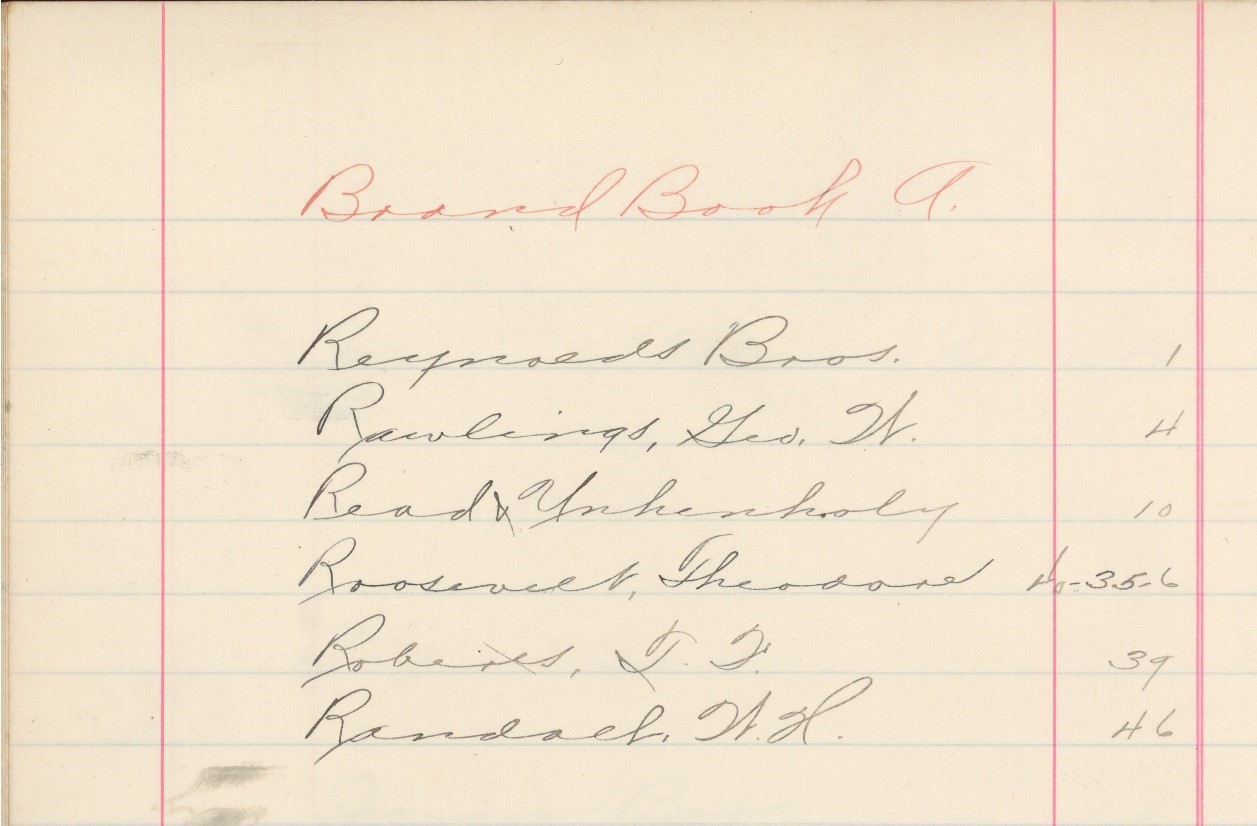
Theodore Roosevelt’s index listing in Volume 7, State Series 30005
The first brand, found on page 35 of Volume 1, State Series 30003, is for Roosevelt’s Maltese Cross Ranch. Roosevelt registered the brand in Billings County for horses and cattle in that county as well as in Stark and Morton counties. The cross design was applied to the left hip on horses and the left hip and right sides of cattle. Registration was made Oct. 11, 1890, but was ultimately canceled due to abandonment of the registration Nov. 1, 1913.
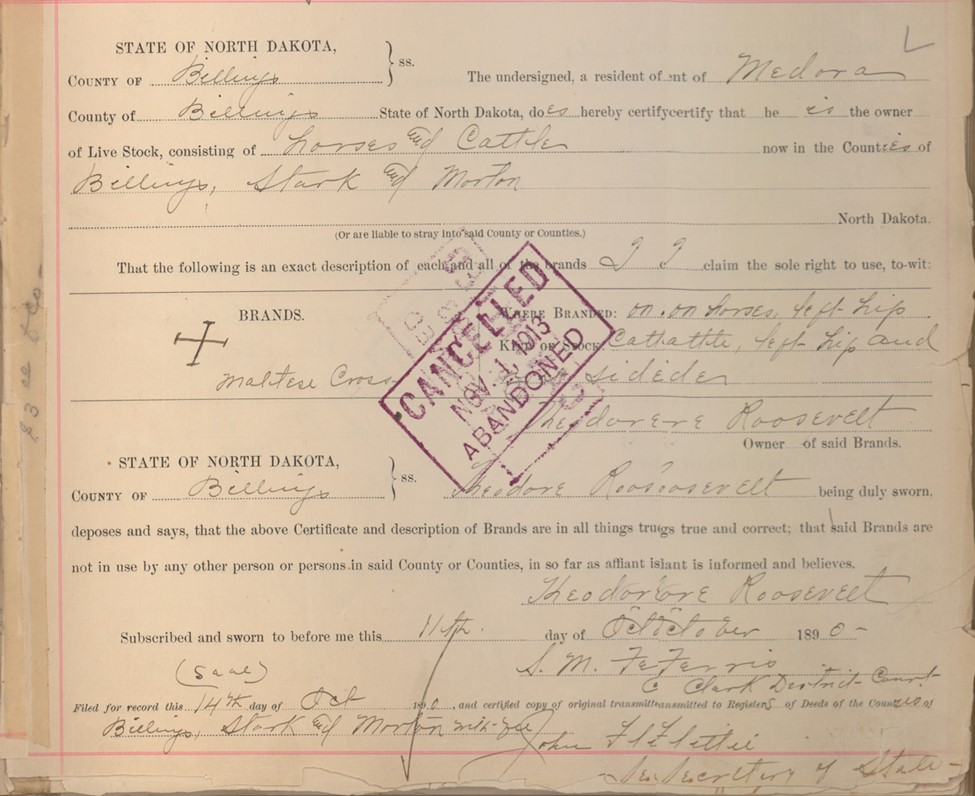
Theodore Roosevelt’s Maltese Cross brand registration in Volume 1, State Series 30003
The second brand he registered was for the Elkhorn Ranch. Found on page 36 of Volume 1, State Series 30003, Roosevelt registered this brand the same day (Oct. 11, 1890) as the Maltese Cross brand. The Elkhorn brand mark was for both horses and stock, with the branding location on the left shoulder for horses and either side for cattle. The registration was canceled Nov. 1, 1913, with the stamp marking it “Abandoned.”
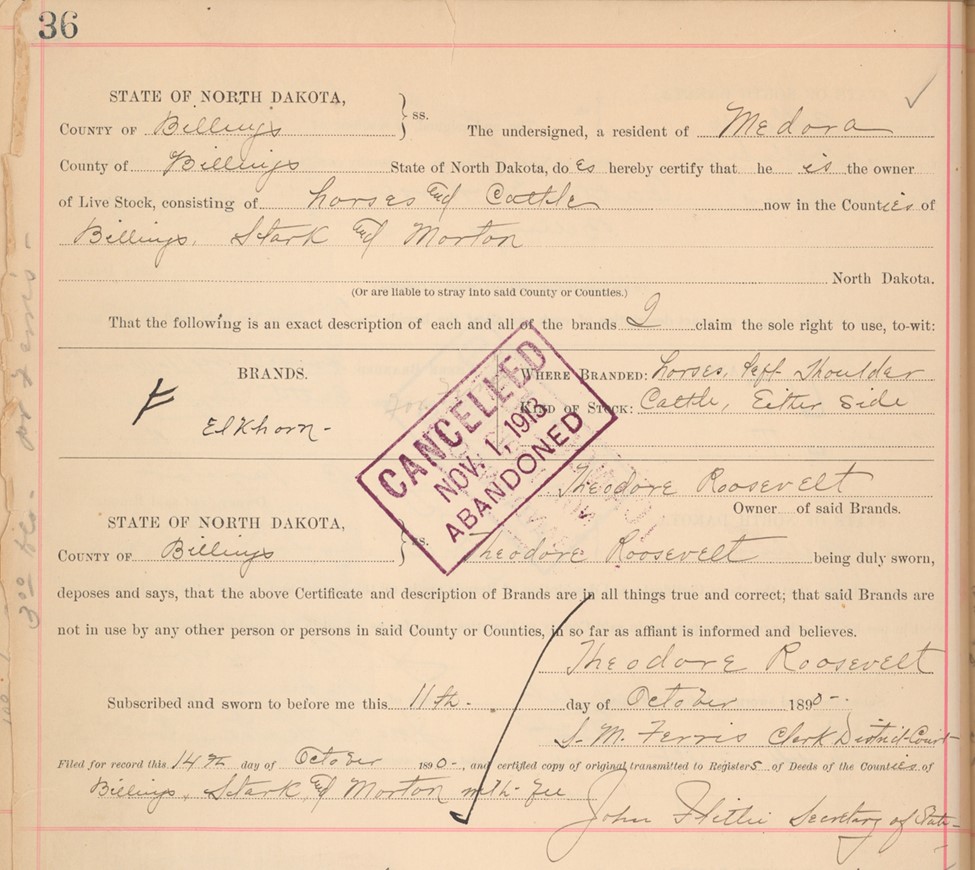
Theodore Roosevelt’s Elkhorn brand registration in Volume 1, State Series 30003
His third registered brand is a simple triangle. Registered the same day as his other brands, this brand appears to be affiliated with his Elkhorn Ranch based on information included in a National Park Service Historical Handbook on Roosevelt’s time in the Badlands. It, too, was later canceled Nov. 1, 1913 and considered abandoned based on the stamp.
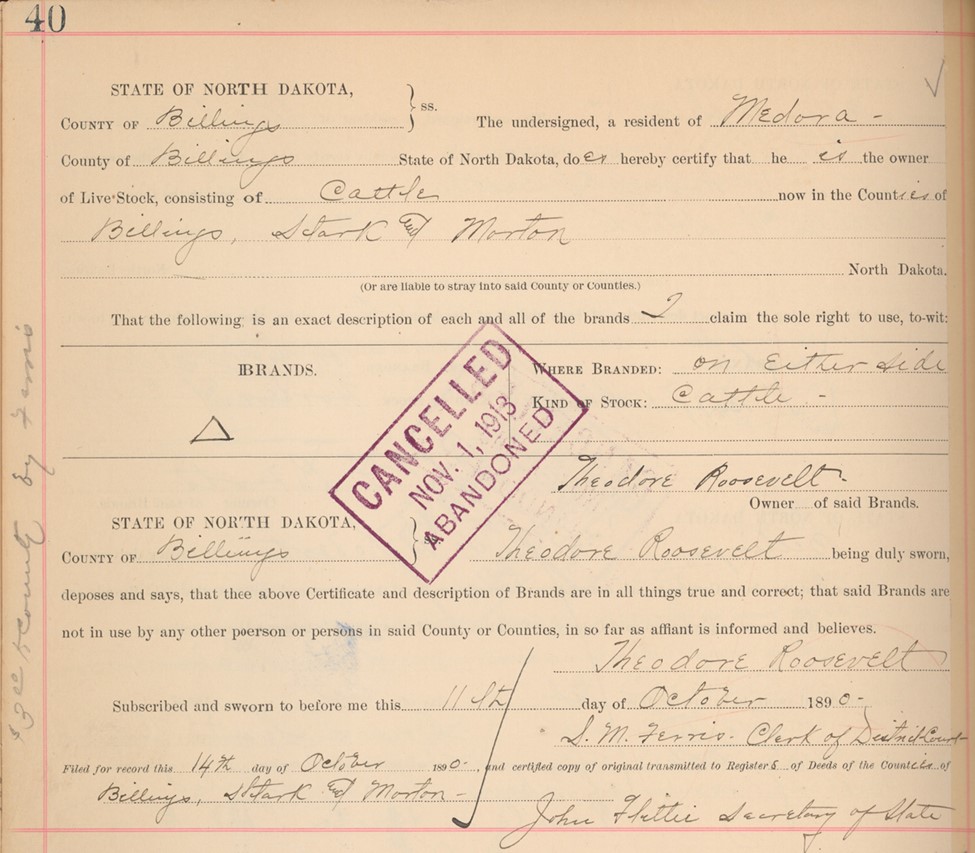
Theodore Roosevelt’s triangle brand registration in Volume 1, State Series 30003
It is important to note that Roosevelt had been out of the cattle business for several years by 1913 and his large-scale operations had ceased before these brands were registered with the state. He was still engaged in the cattle business in the early 1890s, so registering the marks made sense. At the time, he was attempting to recoup losses from the brutal 1886-87 winter that decimated herds and brought an end to many of the open range cattle operations in the Badlands.
Finding Roosevelt’s brand registrations was exciting as they allow researchers and curious visitors a chance to connect an ordinary series to an American icon, providing a better understanding of how the series is organized and enhancing accessibility for individuals researching ancestors who raised stock in North Dakota.
Whether you are a TR aficionado or someone looking for your family’s brand, come to the State Archives and arrange to view the brand books. Your journey into North Dakota’s past awaits!