




Picture yourself doing the following:
- Looking at photographs or portraits of unidentified individuals and wondering whether anyone remembers who they were or if someone is looking to know more about them.
- Recording someone today so that a great-great-granddaughter, who isn’t even born yet, can hear their voice one day.
- Reading letters and becoming the memory keeper of the writer and recipient.
- Helping people find a loved one’s grave or reconnecting a family with a story they thought was lost.
- Realizing that a preservation decision or description of a record you made today may determine whether someone 150 years from now finds their great-grandmother’s story.
At the State Archives, we are entrusted with preserving not only information but memory itself. We are honored to be keepers of the past and present—helping the future connect with both. Memory links generations and forgetting these memories is a profound loss to subsequent generations. Ensuring that the stories of those who came before us are preserved is something that archivists take on every day. People often think of archivists as working with dusty boxes full of old papers and photographs. What they don't see is the emotional labor that comes with preserving the stories and memories inside those dusty boxes.
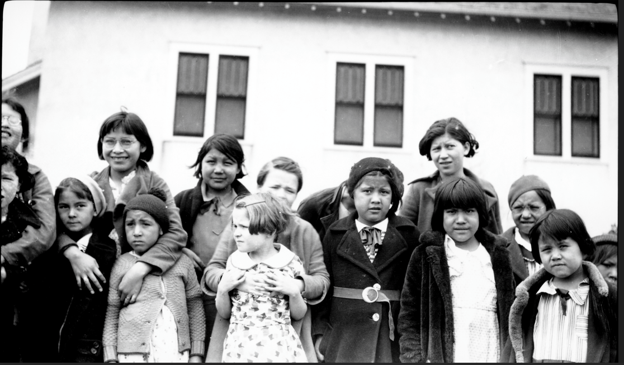
Schoolchildren at Fort Berthold Mission in Elbowoods, circa 1930. When working with photographs, I often find myself thinking about the individuals captured in them. What were their names? Who were their families? Do they have descendants? What did they go on to do in life? What were they like? SHSND SA 00041-01123
On any given day, an archivist may hold a soldier’s final letter home, read a diary entry describing a hardship, or process photographs of communities forever changed by disaster. We preserve records of war, violence, crimes, and prejudice alongside celebrations, milestones, and moments of joy.
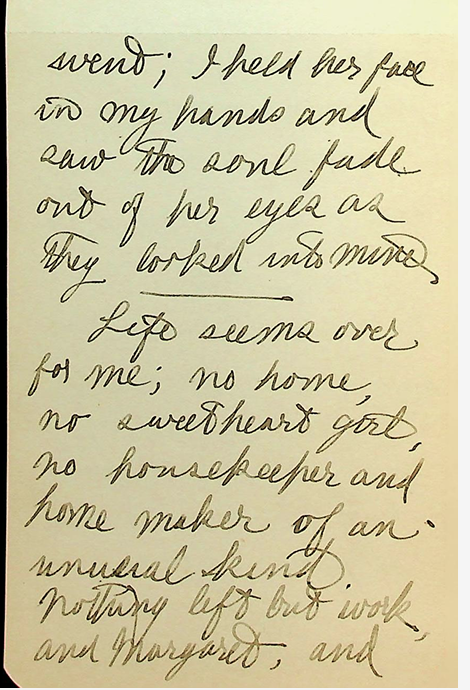
Bismarck businessman George F. Will’s Feb. 19, 1919, journal entry reflecting on the death of his wife, Katharine. Journals preserve more than the memories of the writer; they can also capture deep emotions. Sometimes those emotions are so raw that as I work with these documents I find myself carrying a little of their weight, too. SHSND SA 10190-0036-003
We help families searching for the only surviving photograph of a grandparent, researchers hoping to identify an individual in an unmarked grave, Tribal Nations working to reconnect ancestors’ stories with their people, veterans looking for documentation of military service, and families seeking answers to questions that may have remained secret for generations. We work to ensure those who came before are not forgotten.
In these moments, an archivist is more than a keeper of old records and becomes akin to a trusted confidante. I’ve shared laughter, tears, hugs, and high fives from total strangers when assisting with searches. However, we cannot always provide the answers people hope for. Sometimes the records no longer exist. Sometimes they were never created in the first place. Sometimes they hold painful answers. We preserve both the accomplishments and failures of history because future generations deserve an honest and true record of the past.
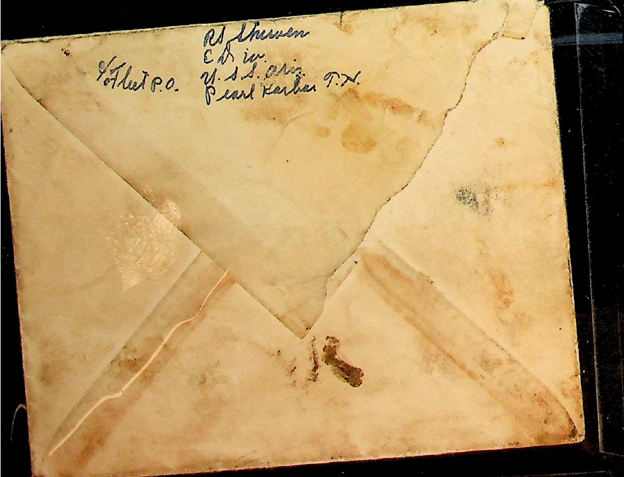
Return address on a Nov. 11, 1941, letter from Richard S. Sherven to Harold Skogstad. Sherven, originally from McKenzie County, was stationed aboard the USS Arizona. Less than a month after sending this letter to his friend, Sherven was killed during the Dec. 7, 1941, attack on Pearl Harbor. SHSND SA MSS 20826
That said, it’s important to remember that as archivists we cannot let emotion influence how we care for records. But we also cannot pretend the stories we work with leave no impression. There are collections that stay with us long after we’ve closed the box for the day. Every decision we make aims to ensure these memories are protected and accessible. The way a collection is arranged, described, or preserved affects whether someone decades from now will be able to connect with a memory of a loved one.
Our responsibility is to help memory survive. That responsibility is profound. Each archivist at the North Dakota State Archives is honored to carry this weight on behalf of the people of this state and region—past, present, and future.