




Hello and happy American Archives Month from the staff of the State Archives! With thousands of record collections documenting the history of North Dakota from the territorial period to yesterday’s news, there is so much to learn from our holdings here. I’m always interested in finding out what information can be found in collections that might not have been the original intention of its creators or what you might think based on the title and summary. To find out, I selected a collection at random from the State Historical Society’s online catalog, fiNDhistory, and asked State Archives staff to tell me what other aspects of history they think this collection can shed some light on, apart from its main subject of genealogy.
The collection I chose is MSS 11059: Muir and Kloubec Families Papers. It contains letters, census records, photographs, and other genealogical records documenting the Kloubec and Muir families.
Let’s see what they came up with!
Lindsay Meidinger, deputy state archivist
Researchers can use census records (originally used for genealogy research in this collection) and family histories to study occupations, including how particular types of work changed over time and how those changes affected the daily lives of workers and their families. For example, the Kloubec and Muir Families Papers could provide insight into how occupations such as laborer, farmer, or “at home” shaped family life or how an individual’s occupation changed after immigrating to the United States.
Emily Kubischta, manuscript archivist
The census records included in these papers can also shed light on differences in data collection points between the Canadian census, U.S. federal census, and various state censuses. Understanding which data points were prioritized may bolster research on national, regional, or local politics.
Sarah Walker, head of reference services
There is a lot to be gleaned from genealogical collections and in a multitude of ways! In this collection, there is a photo of a woman standing in a garden in front of a house. The handwritten note on the back states that this was “Uncle Laughlan’s daughter Janet” and details the land description documenting where this family home was situated. That alone is a goldmine for researchers looking into the family, irrespective of the genealogical value.
However, what really catches my eye is a small rectangular label on the back containing internal information from the photography studio that issued this print, including the photo number and the studio’s name. So cool! We can use this to look up information about the photography studio that produced this photo, learn more about how such a business operated and how photo orders were carried out (an additional copy cost 50 cents!), and get the bonus of seeing a very personal behind-the-scenes view of a family that wanted to preserve their history pictorially. How relatable it is to see that they, like us today, wanted to hold a picture near to them of their family and home—perhaps it was once over a mantelpiece or on display elsewhere in the very family home pictured.
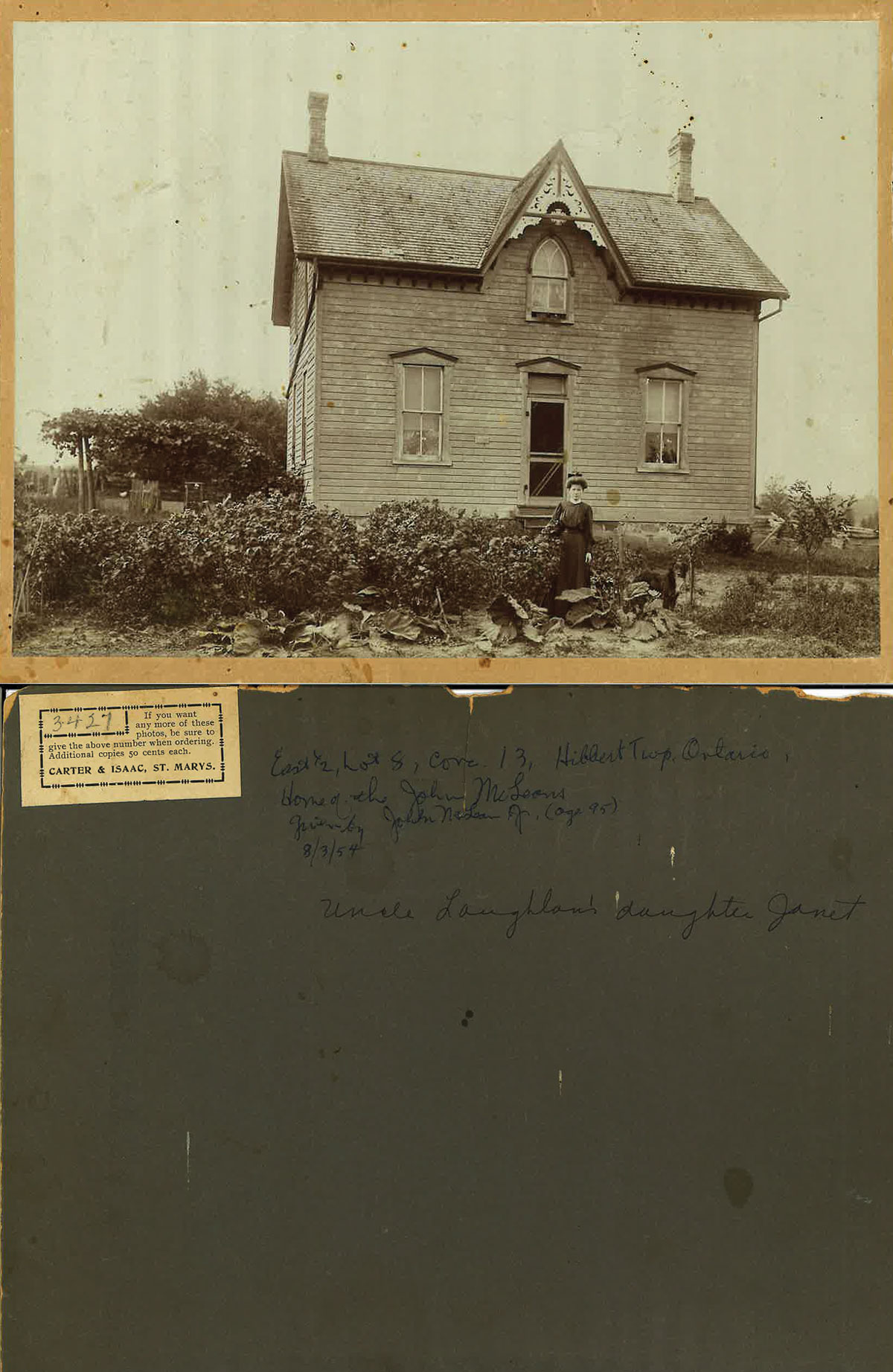
Front: Undated photo of the home of John McLean, a relative of the Muir branch of the family, Hilbert Township, Ontario.
Back: Don’t forget to flip a picture over! Information about the family, location of the home, and the photo studio that produced this print can all be found on the reverse. SHSND SA 11059-00001
Virginia Bjorness, head of technical services
The primary contributor to this collection, Wallace Muir, wrote of growing up in LaMoure during the Great Depression (Box 1, Folder 22), which gives us insight into everyday life at a critical moment in our nation’s history. He writes about years of want and foreclosures, the general attitude to federal programs, and, of course, the terribly dry, hot summers during this time. Lighthearted stories of childhood experiences with his twin brother, Willis, are woven throughout this short biography.
Additionally, this collection is an amazing example of how to conduct genealogy generally, or at least how to conduct it in the 1980s and 1990s (before Google and Ancestry became household names). In addition to photocopies of census records, plat maps, marriage records, and newspaper clippings, this collection is loaded with correspondence and research notes. Wallace (Wally) Muir wrote numerous letters to far-flung relatives in the hopes of getting a more complete understanding of the whereabouts and lives of his ancestors, and he took and included copious notes and quizzical, or perhaps frustrated, musings, such as “Having two Anthony Kloubecs is a little confusing. They both were the same age and lived next door to each other” (Box 1, Folder 2). You never know what speedbumps will arise when researching family history or how many others will gladly pitch in to connect the dots.
Greta Beck, audiovisual archivist
I took a closer look at correspondence between Wallace Muir and Elaine Lundberg who were coordinating efforts to research their families’ genealogy in the 1990s. Future historians could use the correspondence to study how two people chose to communicate in a time when one had the option of using a word processer on a computer to type and print a letter, sending a physical letter through the mail, or using computers to send emails.
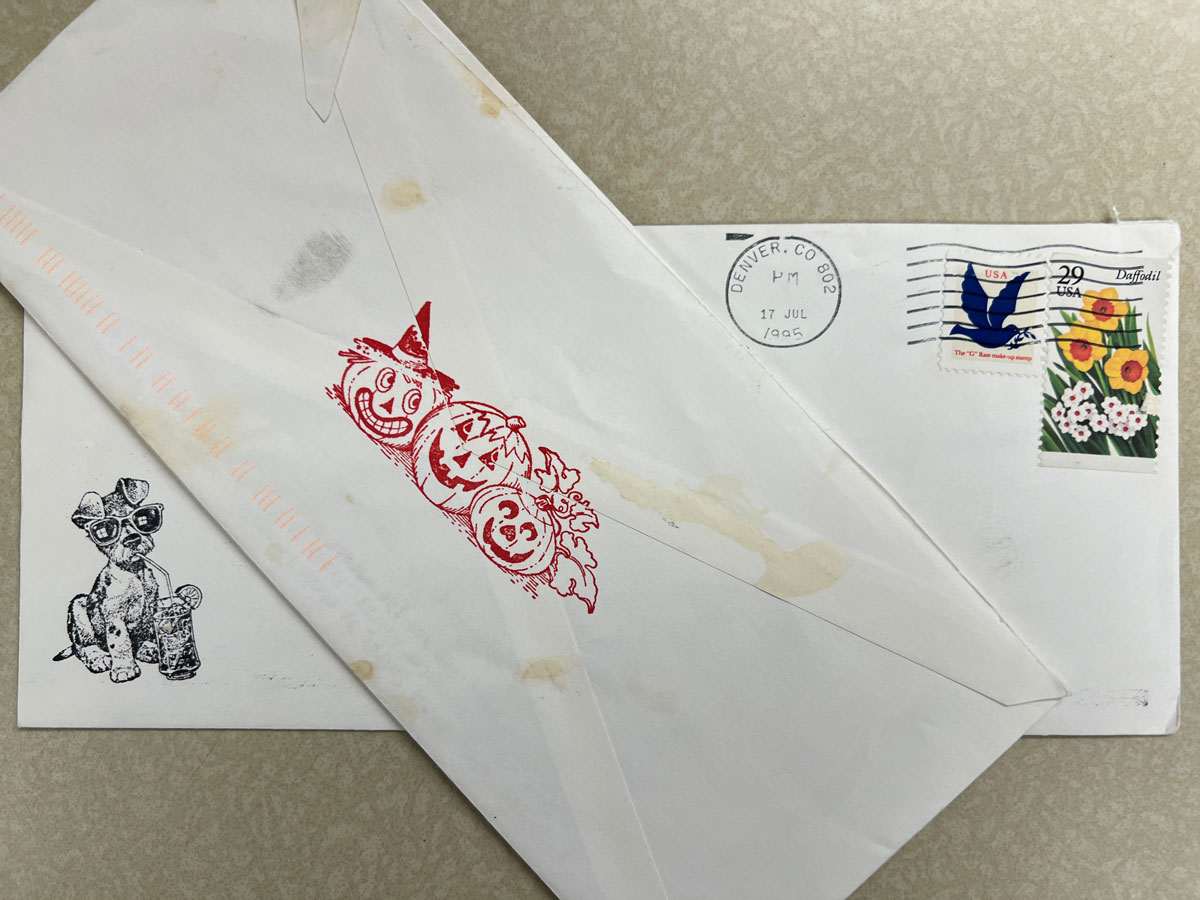
Letters from Box 1, Folder 5 of the Muir and Kloubec Families Papers. Along with the required postage, some of the letters are decorated with fun seasonal stamps. SHSND SA MSS 11059
Thinking outside the box or thinking outside the collection title/description, can open up so many more information sources, ideas, and avenues for interpretation to researchers, though it might not be easy to do! If you have questions about researching North Dakota history or the State Archives collections, send us an email, archives@nd.gov. Our reference staff would love to assist you in finding the right collection to help with your research!