Backstage Pass to North Dakota History

This blog takes you behind the scenes of the State Historical Society of North Dakota. Get a glimpse at a day-in-the-life of the staff, volunteers, and partners who make it all possible. Discover what it takes to preserve North Dakota's natural and cultural history.

Boom and Bust: Creating a North Dakota History Game to Teach High School Economics
A Powerpoint slide that reads Economics in North Dakota. 1975-1985. A game of real-life occurrences. There are also two black dice on a yellow background with white and yellow squares around them.

What if your next economics lesson didn’t start with a textbook, but with a dice roll? When a local teacher reached out asking if I had any lessons related to economics for a class of high school students, I saw this as a perfect opportunity to make history relevant and engaging for young people. Thus was born a project combining state history, economic theory, and game-based learning into a hands-on classroom experience. The result was a game exploring the agriculture and oil booms and busts of northwestern North Dakota between 1975 and 1985.

Why then? The late 1970s and early 1980s were a time of dramatic economic swings in our region. High oil prices and strong wheat markets brought prosperity to many communities, followed by sharp downturns that left lasting impacts. These cycles of boom and bust offer a powerful lens for teaching key economic concepts like supply and demand, market speculation, and resource dependency.
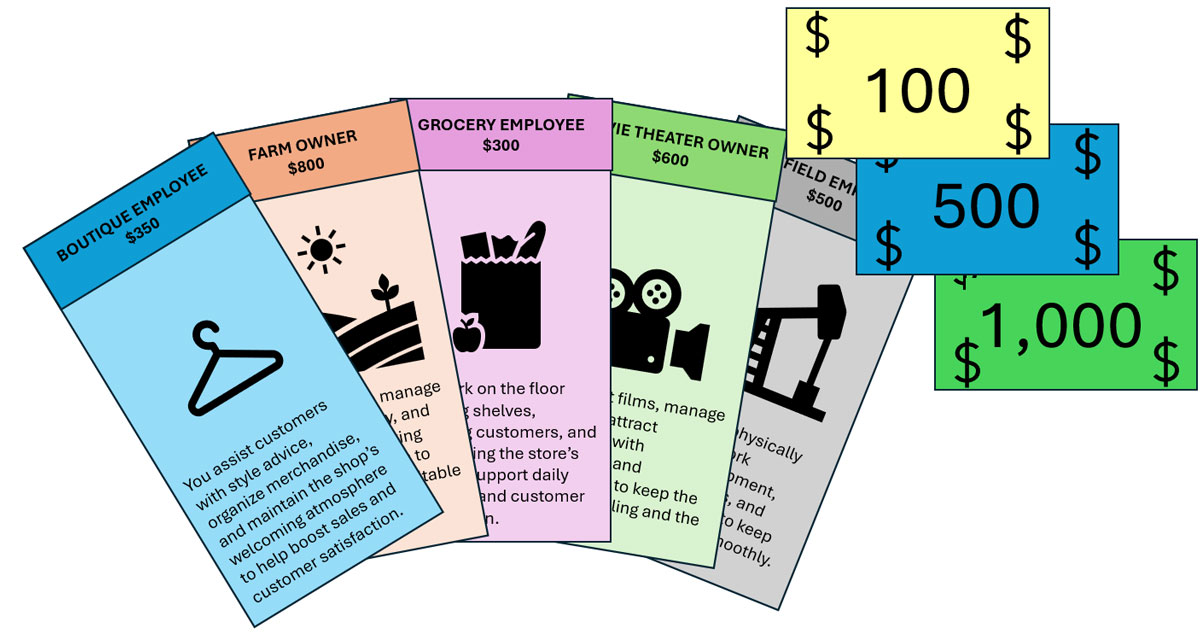
Monopoly looking cards with employment opportunities such as boutique employee (clothes hanger icon), farm owner (field icon), grocery employee (bag of groceries icon), and movie theater owner (old projector icon) as well as a yellow $100 bill, blue %500, and green $1000.

Career cards describe each community member’s job role and salary. Play money is used for transactions in the game.

In this economics game, students assume jobs in the community such as teacher, rancher, or oil worker. Then they roll the dice to advance the game and determine the fate of that group. Each game square represents an event inspired by real newspaper clippings from McKenzie County. Each round is a year between 1975 and 1985. Players must make decisions about investing in oil rigs, expanding farms, buying insurance, and building infrastructure, while navigating unpredictable market shifts, weather events, and policy changes.
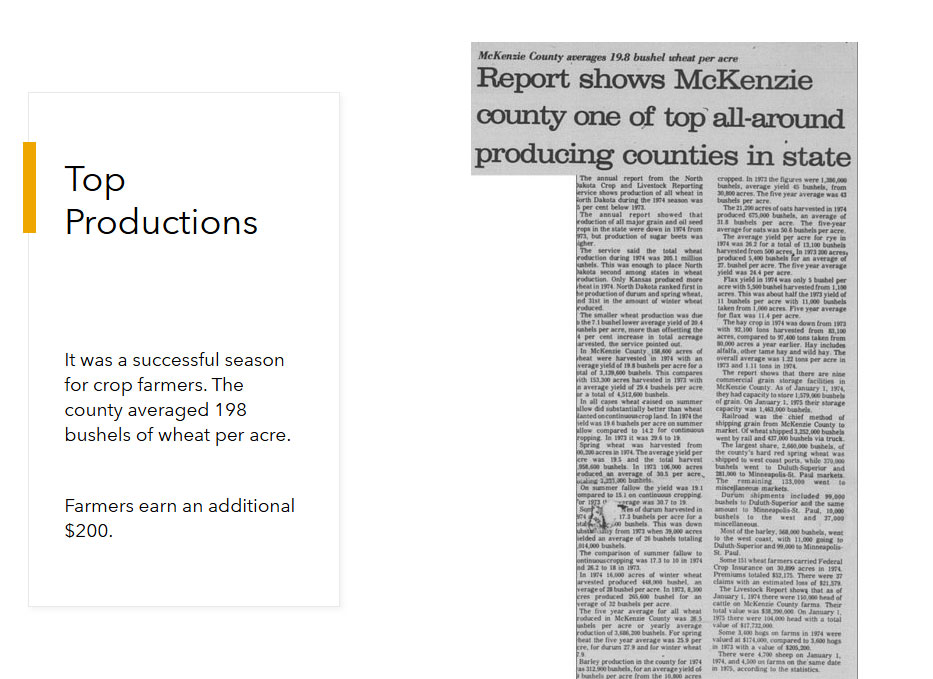
A Powerpoint slide that reads Top Productions. It was a successful season for crop farmers. The county averaged 198 bushels of wheat per acre. Farmers earn an additional $200. There is a newspaper article along side it titled Report shows McKenzie county one of top all-around producing counties in state.

Game squares contain a newspaper clipping and detail the impact the report has on careers in the game.

By the end of the game, students have gained an understanding of how history and economics intersect in their own backyard and grappled with the challenges of economic decision-making under uncertainty.

Through this game, students don’t just learn about economics, they live it. By stepping into the shoes of real community members and navigating the volatility of boom-and-bust economies, they gain a deeper appreciation for how market forces shape lives, towns, and futures. It’s a powerful reminder that history isn’t just something we read about, it’s something we can simulate, question, and learn from. In doing so, we help students connect classroom concepts to real-world stories rooted right here in North Dakota.
From Trash to Toys: Making Supplies for Education Programs

If I had a nickel for every time I called and asked for local businesses’ “garbage,” well, I’d only have 10 cents. But strangely, that’s already happened twice.

I work as the education outreach supervisor, and much of my role involves developing programs that help visitors connect with and better understand the history of North Dakota. One program I lead is called “Native American Sports and Games,” where we share activities that have been played for hundreds of years by the Indigenous people of the Great Plains. Some of these games include lacrosse, double ball, ice gliders, hand game, and bone and pin. This program has become quite popular with visiting school groups, and the items in our games bin see a lot of wear and tear. Because of this, I occasionally need to repair or replace our equipment. While there are plenty of outlet stores and online retailers that sell similar items, I have a crafty heart and a bit too much confidence in my ability to DIY just about anything. Rather than buying new gear, I sometimes try making it myself.

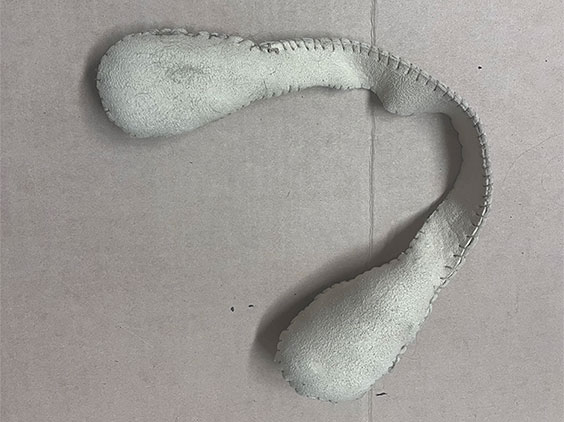
The first item I decided to make was a double ball. Fortunately, I had most of the supplies on hand. The materials I needed were simple: buckskin leather, sinew, and bison hair. I had a few pieces of buckskin left over from a previous project, and a large roll of imitation sinew. But I didn’t have any bison hair—and alas, no bison to groom! That halted the project for a moment, but then I realized that bison hair was likely chosen for its abundance and convenience. So I started thinking: What other natural fiber could I easily get my hands on? Dog hair! A quick phone call to a local pet groomer, and I asked if I could have their end-of-day garbage bag filled with dog hair. They found the request a bit odd but were happy to oblige. And just like that, the project resumed. With all the materials in place, I was able to successfully make an additional double ball for the program.

a double ball made of buckskin, imitation sinew, and dog hair clippings

Completed double ball made of buckskin, imitation sinew, and dog hair clippings.

This fall, I took on a second DIY project: bone and pin. To make this game, you need deer phalanges (toe bones), long bone or antler, leather cord, and another piece of buckskin. I already had the leather supplies on hand, but despite my best efforts, I couldn’t find reasonably priced deer phalanges anywhere. Luckily, fall in North Dakota means one thing: hunting season.

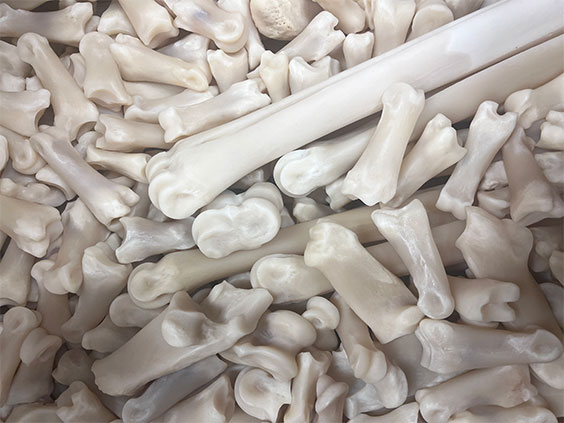
I called up my local butcher and asked if I could have the phalanges from any deer being processed. He couldn’t clean out just the phalanges but could give me the entire lower leg portion. I was thrilled and happily agreed. A few weeks after deer opener, I picked up a box of 44 deer legs from the butcher and brought them to work. With the help of Becky Barnes, a paleontologist with the North Dakota Geological Survey, I learned the process for removing and cleaning bones from the hooves. I will save you the gory details but will say I became adept at removing the flesh and tendon from bone. We washed the bones in a soap water solution and left them to soak in ammonia to remove any remaining oils. After soaking for a few months, the bones were clean and ready to be shaped.

a pile of cleaned lower leg and hoof bones from deer

Cleaned lower leg and hoof bones from deer.

I plan to shape them using drills and sanding belts. Finally, I’ll string the pieces together to complete the game set.

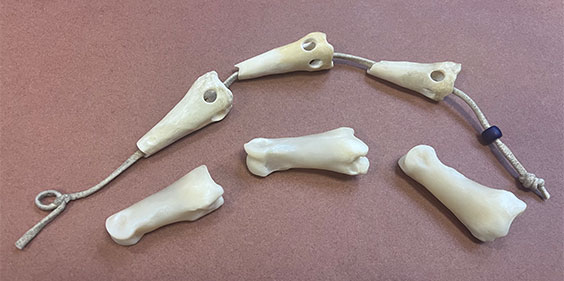
three small bones with holes around the tops are shown on a string with three regular bones underneath

Bones shaped for bone and pin strung together on leather alongside unshaped phalange bones.

I’m grateful for these unusual opportunities because they not only connect me to our history but also to my community. In the end, I’m proud to say that both these DIY projects seem to be on a successful track. And as a bonus, I was able to repurpose what would have otherwise been waste from local businesses into meaningful educational items.